
Outlook: global economy and financial markets
Robust growth amid falling oil prices
The global economy continues to show signs of robust health as 2026 draws to a close. Despite the temporary increase in energy prices resulting from the conflict in Iran, global economic growth in the first three quarters exceeded its potential. This development was underpinned by robust consumer demand, solid business investment, and the ongoing AI investment cycle, which provided significant growth impetus, particularly in the United States and parts of Asia.
At the same time, the recent sharp fall in oil prices is providing additional momentum, as the purchasing power of private households is improving once again.
Our base-case scenario therefore remains unchanged: an environment of inflationary growth and economic resilience. Although the phase of rapid acceleration in the AI boom is likely to be over, the structural investment trends remain intact and continue to point to above-average momentum in key sectors of the economy.
Please note: investing in securities involves both opportunities and risks.
Inflation and monetary policy – decline with uncertainties
Inflationary pressures remain high for the time being: higher energy, transport, capital, and goods costs continue to drive up prices. At the same time, the fall in oil prices could lead to a faster decline in inflation than previously expected.
Central banks are responding with cautious interest rate adjustments to inflation, which remains above their target levels. Both the US Federal Reserve and the European Central Bank are likely to continue their interest rate cycles, albeit at a moderate pace. The aim remains to stabilise long-term inflation expectations without unnecessarily jeopardising economic expansion.
Equities – overweight allocation remains in place
The fundamentals for equities remain favourable. Economic growth is above potential, company earnings are solid, and the risks of recession remain limited. At the same time, numerous sectors continue to benefit from investment in artificial intelligence, digitalisation, infrastructure, and the development of resilient supply chains.
Uncertainty surrounding the AI investment cycle has, admittedly, increased. Financing risks, regulatory debates, and high expectations for technology shares are leading to heightened volatility. From today’s perspective, however, the positive fundamental factors continue to outweigh the negative ones, which is why we are overweight in equities.
These are our preferences within the equity sector:
- European dividend strategies
- European small caps
- Latin America
- Global metal and mining companies
- US technology shares
- US quality and dividend shares
Bonds – more attractive perspective
The outlook for the bond market has improved. The fall in oil prices and the rise in yields have made the risk-reward ratio of bonds more attractive. At the same time, while central banks are likely to implement further interest rate hikes, these are not expected to exceed the markets’ current anticipations.
Against this backdrop, we favour a longer duration and continue to see attractive carry returns, particularly in selected European bond segments. Following the rise in yields over recent months, bonds appear significantly more attractive again in the long term, and we are keeping a close eye on high-yield bonds in Europe and emerging markets local-currency bonds in particular.
Commodities – neutral with constructive picture in the long run
The easing of tensions on the oil market suggests a more neutral outlook for the energy sector in the short term. A lasting stabilisation in the Middle East could take some of the pressure off energy prices. At the same time, geopolitical risks remain a significant source of uncertainty.
Industrial metals continue to benefit from investment in infrastructure, defence, the energy transition, and digitalisation. In an environment of rising government debt and long-term inflation risks, gold remains an important component of a diversified portfolio; however, due to interest rate increases, we are currently neutral on the asset.
Currencies – interest rate differentials are once again favouring the US dollar
The US dollar is benefiting from the recent rise in expectations of further interest rate hikes by the US Federal Reserve. By comparison, the European Central Bank’s room for monetary policy manoeuvres appears more limited.
In this context, interest rate differentials have once again shifted in favour of the US dollar. We therefore currently prefer a position in favour of the US dollar against the euro. We remain neutral on the British pound and the Japanese yen, however.
Summary of our investment strategy
The most likely scenario remains one of robust global growth accompanied by moderate inflationary pressures. While the risks surrounding the AI investment cycle have increased, they are offset by continued solid economic performance. In this environment, we are maintaining our overweight position in equities while at the same time assessing the attractiveness of bonds as higher than it was a few months ago.
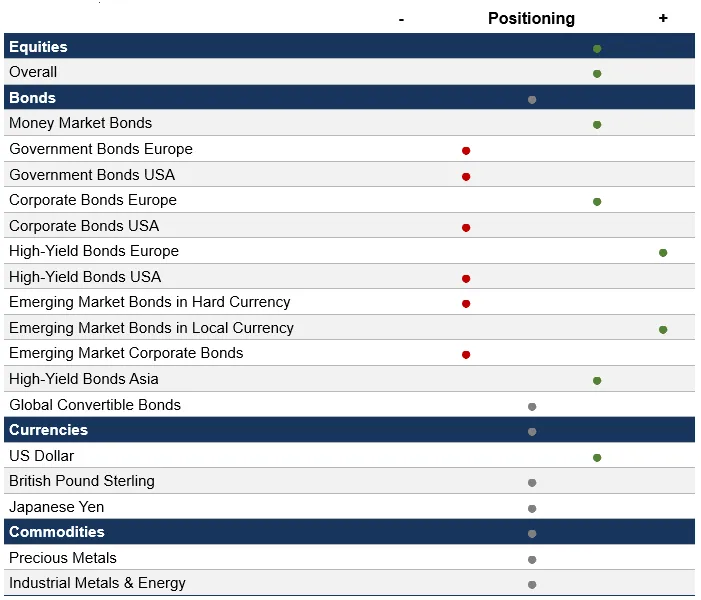
Source: Erste Asset Management, November 2026
Notes: Forecasts are not a reliable indicator of future performance. Where fund portfolio positions are disclosed in this document, they are based on market developments as at 10/11/2026. These portfolio positions may change at any time as part of active management. Please note that investing in securities involves risks as well as the opportunities described.
For explanations of technical terms, please visit our Fund Glossary.
Disclaimer
This document is an advertisement. Please refer to the prospectus of the UCITS or to the Information for Investors pursuant to Art 21 AIFMG of the alternative investment fund and the Key Information Document before making any final investment decisions. Unless indicated otherwise, source: Erste Asset Management GmbH. Our languages of communication are German and English.
The prospectus for UCITS (including any amendments) is published in accordance with the provisions of the InvFG 2011 in the currently amended version. Information for Investors pursuant to Art 21 AIFMG is prepared for the alternative investment funds (AIF) administered by Erste Asset Management GmbH pursuant to the provisions of the AIFMG in connection with the InvFG 2011. The fund prospectus, Information for Investors pursuant to Art 21 AIFMG, and the Key Information Document can be viewed in their latest versions at the web site www.erste-am.com within the section mandatory publications or obtained in their latest versions free of charge from the domicile of the management company and the domicile of the custodian bank. The exact date of the most recent publication of the fund prospectus, the languages in which the fund prospectus or the Information for Investors pursuant to Art 21 AIFMG and the Key Information Document are available, and any additional locations where the documents can be obtained can be viewed on the web site www.erste-am.com. A summary of investor rights is available in German and English on the website www.erste-am.com/investor-rights as well as at the domicile of the management company.
The management company can decide to revoke the arrangements it has made for the distribution of unit certificates abroad, taking into account the regulatory requirements.
Detailed information on the risks potentially associated with the investment can be found in the fund prospectus or Information for investors pursuant to Art 21 AIFMG of the respective fund. If the fund currency is a currency other than the investor's home currency, changes in the corresponding exchange rate may have a positive or negative impact on the value of his investment and the amount of the costs incurred in the fund - converted into his home currency.
Our analyses and conclusions are general in nature and do not take into account the individual needs of our investors in terms of earnings, taxation, and risk appetite. Past performance is not a reliable indicator of the future performance of a fund.